There’s no such thing as a finished commercial estate.
Businesses move in and out, buildings are refurbished and new amenities open. More fundamentally still, the way people use commercial estates has changed beyond recognition. A building that was once solely an office might now be a mix of flexible workspace, hospitality and leisure, while the spaces in between are taking on a much bigger role in how people spend their time.
For estate managers, managing that change is an ongoing challenge. Wayfinding has an important role to play in helping to retain a coherent and consistent sense of place amidst the change.
It's tempting to design for what's in front of us. Where are the buildings? Where do people arrive? What destinations do they need to find?
Those are fundamental questions, but when we're working on larger estates, we also think about what could change.
An office might gain a new occupier. A new phase could be built, or a building could be due for refurbishment. A previously overlooked patch of public realm might become home to a café or flexible meeting space.
A good wayfinding strategy provides a framework that allows a place to evolve. Get the underlying principles right and new buildings and uses can be accommodated without a complete overhaul.
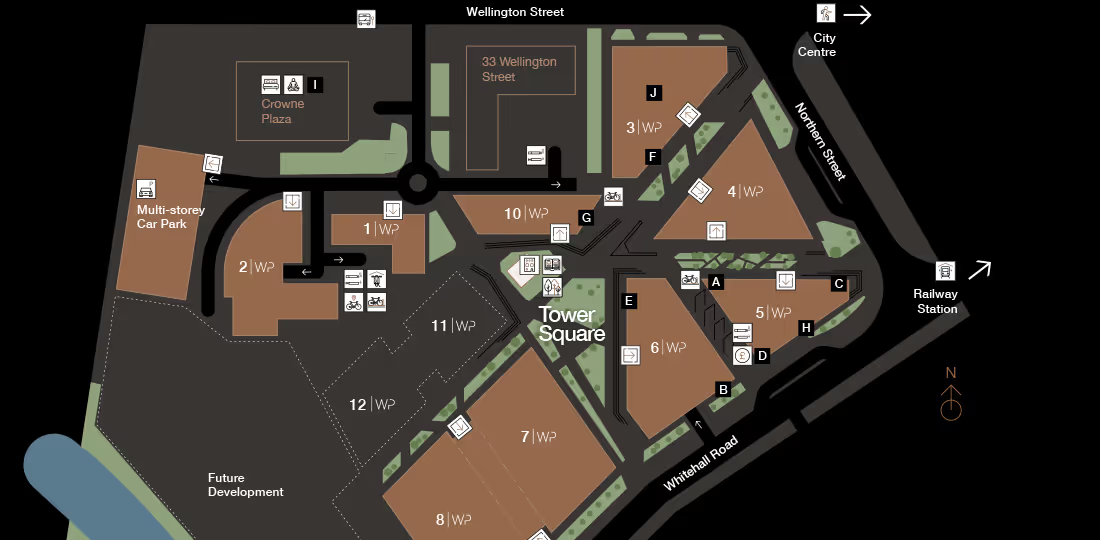
At Wellington Place in Leeds, we developed a wayfinding strategy for a city centre neighbourhood that was still being built out. That meant developing a coherent system and information hierarchy, mindful of future phases of the masterplan. Digital signage formed part of the solution, with screens capable of combining wayfinding information with live bus times and information about upcoming events. The physical and digital elements were designed as part of the same family, allowing information to change while retaining a consistent visual identity. Our latest strategy work at one of Manchester's newest neighbourhoods, NOMA, focuses not only on addressing current needs within the site but also on effectively anticipating future growth and integration with the broader city fabric.
One of the challenges for estate managers is balancing the identity of the overall place with the individual buildings, businesses and spaces within it. People need enough consistency to understand that they're moving through one connected estate, but that doesn't mean every part of it needs to look identical.
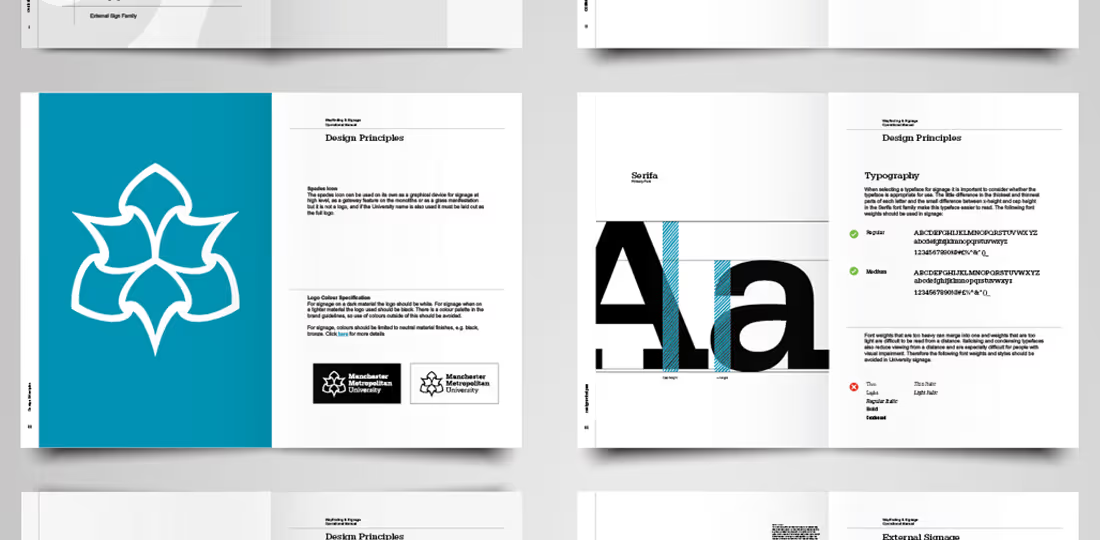
This is where a design manual can be particularly valuable.
It can establish a common language for signage and branding, covering:
That gives future project teams something to work from rather than starting again every time another building or space is changed.
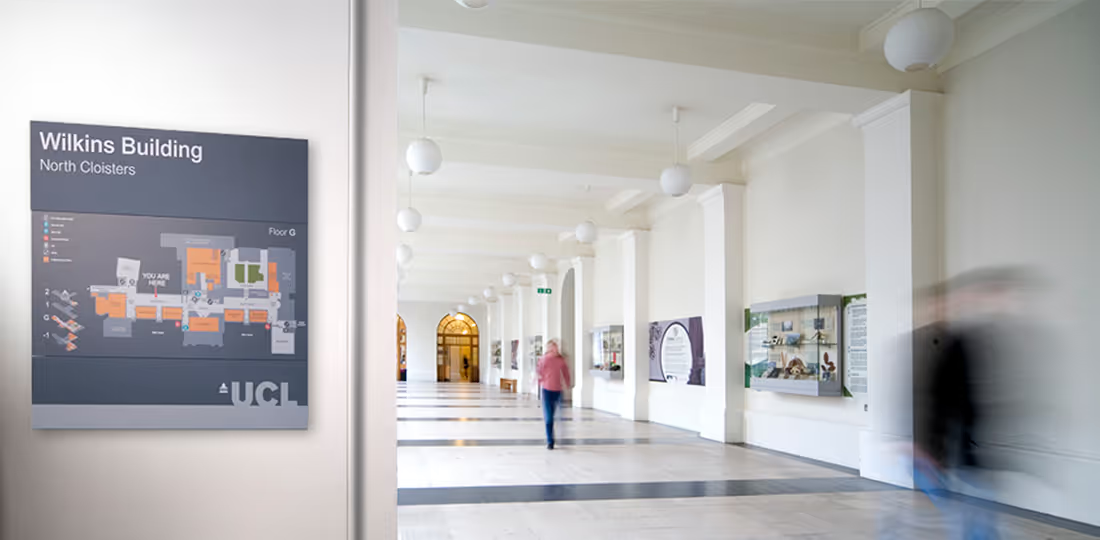
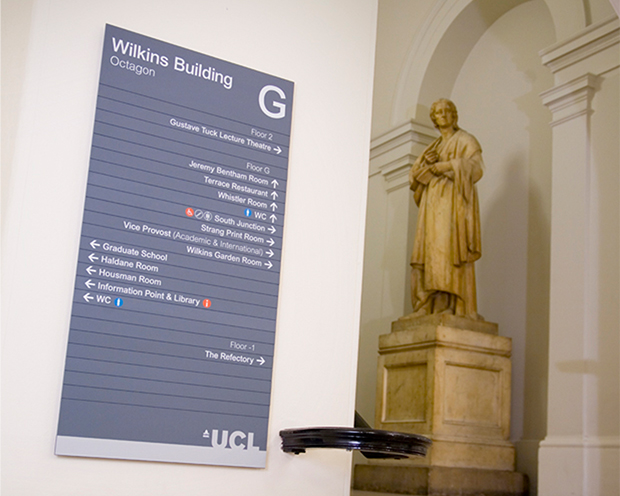
We've seen the importance of this across large university estates, which face many of the same challenges as commercial ones. At University College London, our work has involved developing an internal and external signage strategy to establish consistency with the university's corporate guidelines across a large and complex estate. Individual environments can have their own character while still being recognisably part of UCL.
Many commercial estates have developed over decades. Buildings may be from different eras, and signage may have been installed under several generations of branding. Temporary interventions have a habit of becoming surprisingly permanent.
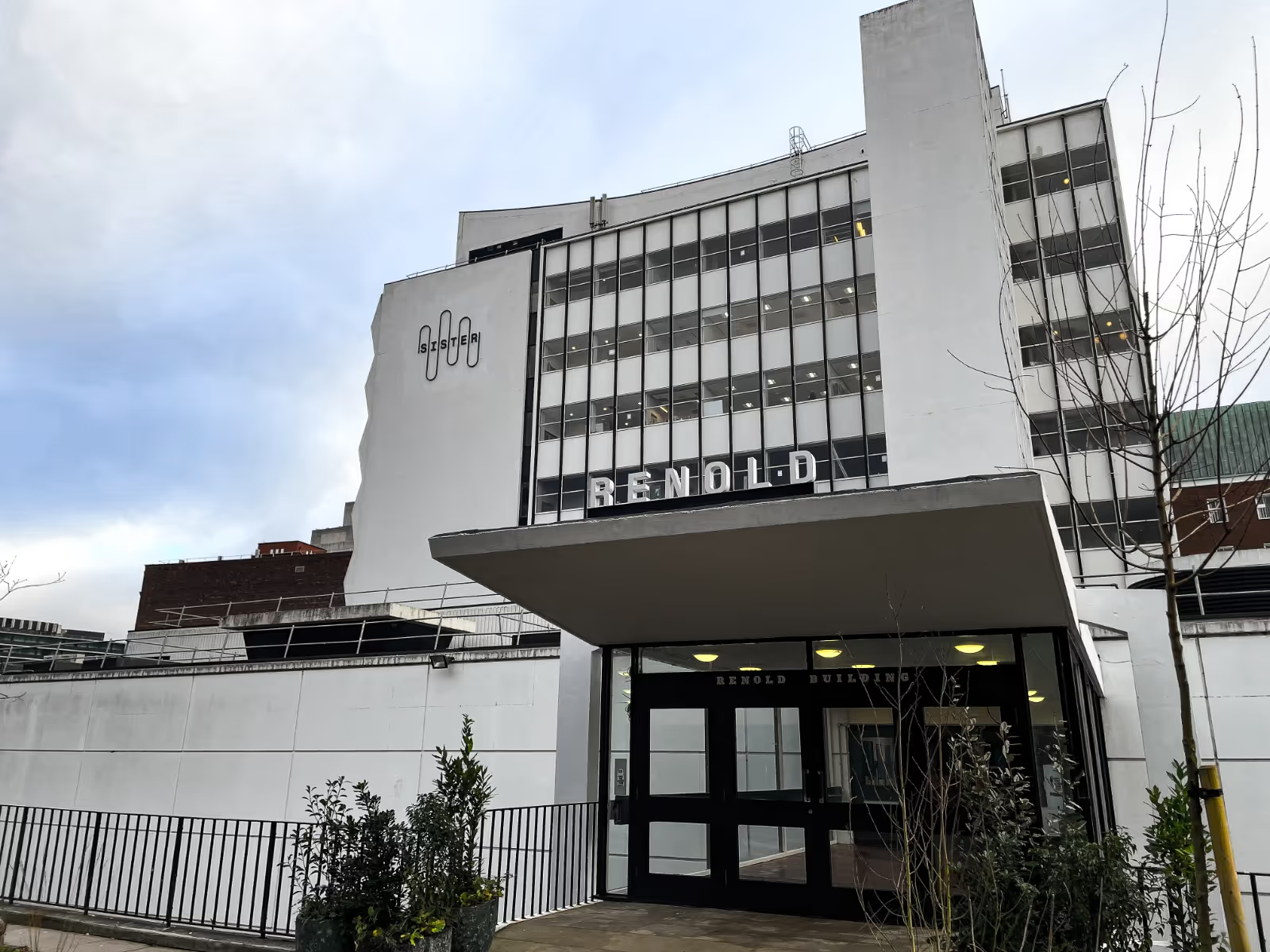
Our work on Manchester's SISTER estate, a joint masterplan project between the University of Manchester and Bruntwood is a case in point. At the Renold Building, our work supported the project's wider retrofit ambitions. The Grade II-listed former UMIST building has been given a new life by Bruntwood SciTech, with the refurbishment retaining and celebrating the character of an important existing building.
Projects like this require a different mindset. Working with what's already there, we consider how wayfinding can elevate a building’s individuality while helping a refreshed asset connect with its surroundings.
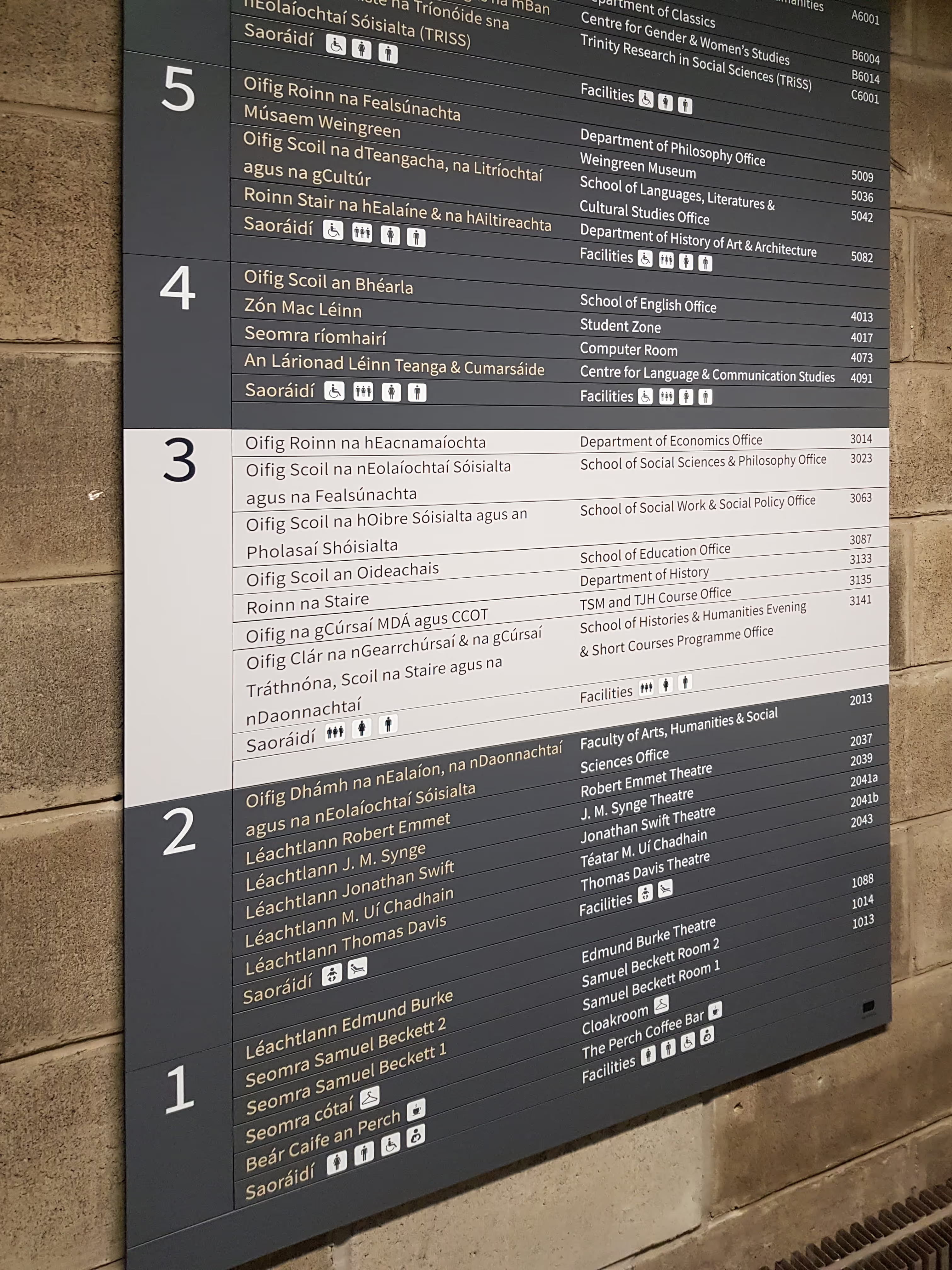
Sometimes the answer is about taking things away. An audit, like the one we carried out at Trinity College Dublin’s Arts Building, gives estate managers the opportunity to look at the whole system again: what’s still useful, what’s duplicated, what’s out of date and where are the genuine gaps?

Major estate changes don’t happen overnight. A refurbishment programme might take several years, with some buildings complete while others remain under construction. Routes change, entrances temporarily move and people still need to get where they're going throughout.
Temporary wayfinding mustn’t be treated as an afterthought. If change is going to last months or years, the temporary experience is a significant part of how people experience a place. Work on the temporary solution at the Renold Building incorporated recycled materials and sleeved around existing posts that could be easily removed.
Manchester Metropolitan University understood this and, as part of its Estate Masterplan Investment Programme, appointed us to develop a signage masterplan that could be implemented in phases across the university's campuses. Temporary and permanent wayfinding worked together so that the campus remained operational and navigable while significant building projects were taking place.
The masterplan established how external signage, building entrances and internal signage should work, while interim signage could respond to the estate as it changed. It all dovetailed with the design manual we’d already created.
On a traditional office park, it can be easy to think of the external space primarily in functional terms: the road that gets someone to the car park, the footpath to reception or the patch of landscaping between two buildings. But as workplaces have evolved, so too have the expectations we place on the areas around them. Outdoor meeting spaces, cafés, events, walking routes and places to sit all contribute to the experience of an estate. The challenge is making those amenities feel like part of one place and encouraging people to discover and use them.
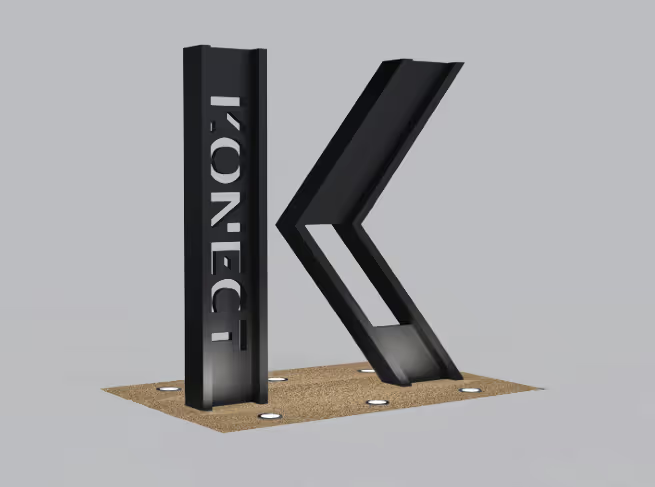
At Konect62, the landscape-led approach to the commercial park included communal areas, vehicle-free routes and spaces for wildlife alongside the industrial buildings. At a bigger scale, Manchester's Oxford Road Corridor incorporates universities, hospitals, research facilities, businesses and cultural destinations across an area equivalent in scale to the city centre itself. Our placemaking strategy looked at how its different character areas could retain their identities while being understood as part of a wider whole.
Future-proofing an estate is about recognising that change is inevitable and designing accordingly. For wayfinding, that means thinking beyond the individual sign. We create clear hierarchies of information, establish consistent design principles and develop guidelines that can be picked up by different teams at different points in the estate's life.
It also means periodically taking a fresh look at what's already there. As an estate changes, does its wayfinding still reflect how people use it? Are new destinations properly connected? Has information accumulated that is no longer helping? And are the spaces between the buildings doing enough to create a coherent experience?
Commercial estates will continue to evolve. Good wayfinding and branding provide a strong framework that can support that change, helping an estate retain its identity and coherence as it evolves.